CWU and AI - Activating members and building towards negotiation

Addressing the complex issues surrounding AI at work can be challenging. It touches on personal experiences, professional roles, and charged political views on Big Tech. It often involves vague or technical terminology. It’s a topic that many employers will see as their ‘management prerogative’ and out of scope for collective bargaining or even worker consultation.
In that context our work with the Communications Workers Union (CWU) – and unions generally – is designed to demystify AI and break down its implications into actionable union responses.
Taking the learnings from Phase 1, in the second phase of our project with the Communications Workers Union, the union led the way to activate its members, while Connected by Data supported the development of a proactive bargaining agenda on AI.
These contributed to strengthening the three part strategy to build CWU power on AI articulated in Phase 1:
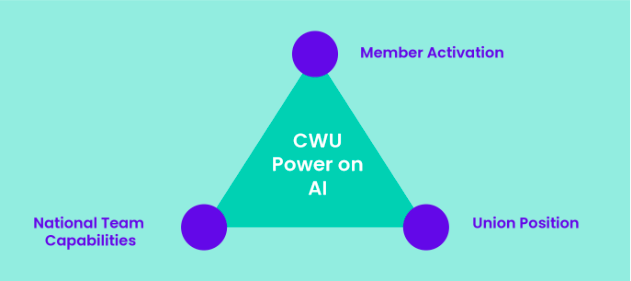
Activating and building member confidence
Following an initial five-month action learning project with the telecoms sector executive (including full-time staff and elected members), the union customised the project approach and materials to reach members across a wider range of workplaces.
Several dozen representatives and members attended five sessions. Adam from Connected by Data led the first two, with the remaining sessions led by CWU officers.
The sessions covered:
-
What does AI look like now? Introducing the current state of AI, core terminology, and examples of its use in daily life (virtual assistants, personalized recommendations, speech recognition, and chatbots). This session also included practical examples of AI’s limitations.
-
What are the impacts of AI on the world of work? Examining AI in the workplace for tasks such as staff monitoring, hiring, and work allocation. The discussion covered potential risks to members, including job displacement, work intensification, and discrimination, as well as potential benefits such as reduced hours and improved efficiency.
-
What AI systems, products and software are currently used in CWU workplaces and how are they used? A practical workshop dedicated to identifying specific AI systems, products, and software used across various workplaces. Key discussion points included data collection practices, members’ current knowledge of these systems, and protections under data protection legislation like GDPR.
-
What control do we have with the implementation of AI in our workplaces? Addressing the legal and collective bargaining landscape of AI implementation. Discussions centered on current legislation, existing collective agreements on AI, strategies for using collective bargaining to ensure union and member involvement in the introduction of AI, and membership education on the topic.
-
What does the future hold with AI in our workplaces? Focusing on future potential uses, risks, and benefits of AI for members and the union. Specific attention was given to the implications of AI in conduct, grievance, attendance, and productivity issues; strategies for dealing with job displacement; and methods for keeping up-to-date with emerging AI technologies.
Workshopping a model collective agreement on AI
In parallel with activating members, we have worked with the union on clarifying the union’s negotiating position. Unions are in the business of bargaining and making agreements, so you have to know what you want.
We convened leading academics, lawyers, and trade unionists to scrutinize a draft collective bargaining agreement designed to be the basis for CWU negotiations with employers.
The model agreement is founded on three high-level principles that anchor the union’s negotiating position:
- Worker voice at all levels of tech decision-making, design, and deployment
- A fair share of AI-related benefits including pay, skills, working hours, and training
- Robust safeguards against bias, discrimination, and other harms
By drawing on excellent resources, such as UC Berkeley’s inventory of collective agreements on technology, we were able to refine these high-level principles and draft them into the form of a contract between workers and employers.
The model agreement is designed to establish a robust, proactive framework for the introduction and use of any ‘high-risk’ AI system that impacts employees, rather than waiting for the employer to take the initiative.
At its core, the agreement establishes a Joint Union-Management AI Committee (JAIC). This committee features equal representation of worker and employer representatives and binding power, meaning no high-risk AI system can be procured or deployed without the union’s explicit agreement.
This proposed committee sparked significant discussion around potential challenges: Could it undermine the union’s independence? What is the process for a deadlock? How will union representatives be resourced and supported to participate on equal footing with management?
The model agreement also draws on the TUC’s AI Bill to mandate a Workplace AI Risk Assessment (WAIRA for high-risk technologies. Additional provisions address collective data rights and skills.
Working from a preliminary draft, we conducted a critical, multi-step assessment of the draft agreement to strengthen its text and inform strategy:
- Scrutinising the model agreement: A detailed review to identify strong provisions and areas needing improvement.
- Anticipating employer pushback: A role-play based discussion to anticipate which provisions are likely to be most contentious during negotiations.
- Identifying essentials vs. desirables: Pinpointing the union’s “red lines” – provisions considered essential – and other key desires to shape an ambitious and achievable negotiation strategy.
Next steps
Connected by Data is continuing to advise CWU as the union looks towards advancing negotiations across multiple employers. Crucially, the approach demonstrates that unions don’t need to be technology experts to assert control over workplace AI, just as many employers aren’t. What matters is clear principles, structured member engagement, and contractual provisions that establish worker voice throughout the AI lifecycle.