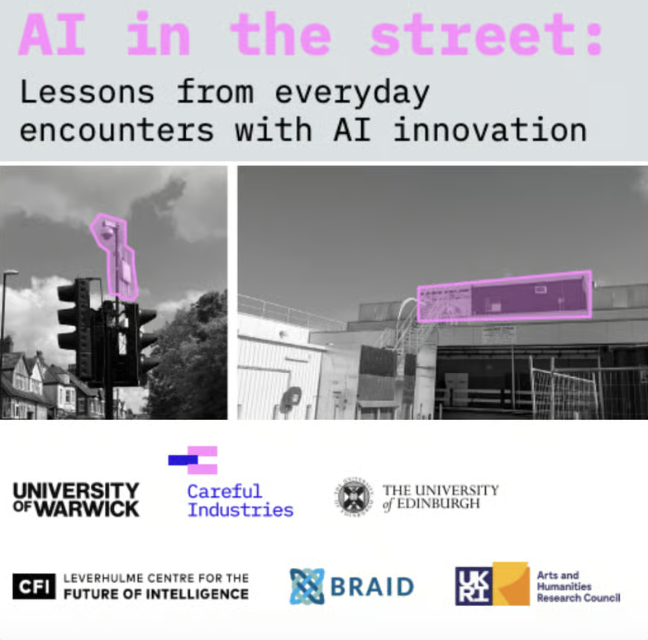
Tim attended a workshop of the AI in the Street project at Newspeak House in London. A brief write-up is below, also shared with additional links and images on Bluesky
Over the last three years, the AI in the Street programme has been exploring how AI shows up in everyday life, and the disjunct between top-down narratives and imaginations of AI and grounded experience.
Through questions and methods that sensitise publics and researchers to the presence of data and AI systems in the mixed public-private space of the contemporary street, the project highlights that citizens mostly encounter AI through proxies.
This resonates with our work on public deliberation on AI: when we move from abstract discussions, to concrete experiences of AI-backed systems, we can both help public dialogue grasp hold of AI, and highlight opportunities for agency.
With growing calls for public deliberation on AI (look out for some exciting community campaign news on this next week) this is a key insight: big debates about the governance of AI will be more powerful if linked to ground-level experience, and the proxies through which AI is encountered.
For global deliberation, we need to understand a diversity of ground-level experiences. For e.g. I was struck that a lens from urban streets risks underplaying certain environmental & biodiversity proxies and impacts of AI. And experiences will vary by country and region.
In the workshop panel, Annie Radcliffe from LGA reflected on tension between local-government up, and government-down visions of what AI will do. How can public dialogue build capacity and mandate of local govt to co-design public sector AI, and resist imposition from above?
In many ways, Matt Davies (Ada Lovelace) & Tim Squirrell (Foxglove) contributions pointed to need for tech-specific ACES (Active Citizens-Effectives States). Public pressure and countervailing power, combined with states sceptical of big-tech claims, and able to shape tech towards public good.
Dominique Barron (Careful Industries) also pointed to gaps in our innovation systems - where AI innovation is not responding to the problems publics face. This raises interesting questions about upstream public participation in research and innovation funding systems.