Reflections from an Expo Booth

From 6-10 July 2026 we were part of a team running a Public AI Voice and Engagement (PAVE) Booth at the AI For Good Global Summit Expo in Geneva, Switzerland. The Booth had been pulled together by a coalition of not-for-profit, research, and civil society organisations seeking an opportunity to promote (among the AI hype that otherwise pervaded the Expo) including public voice in decisions around AI.
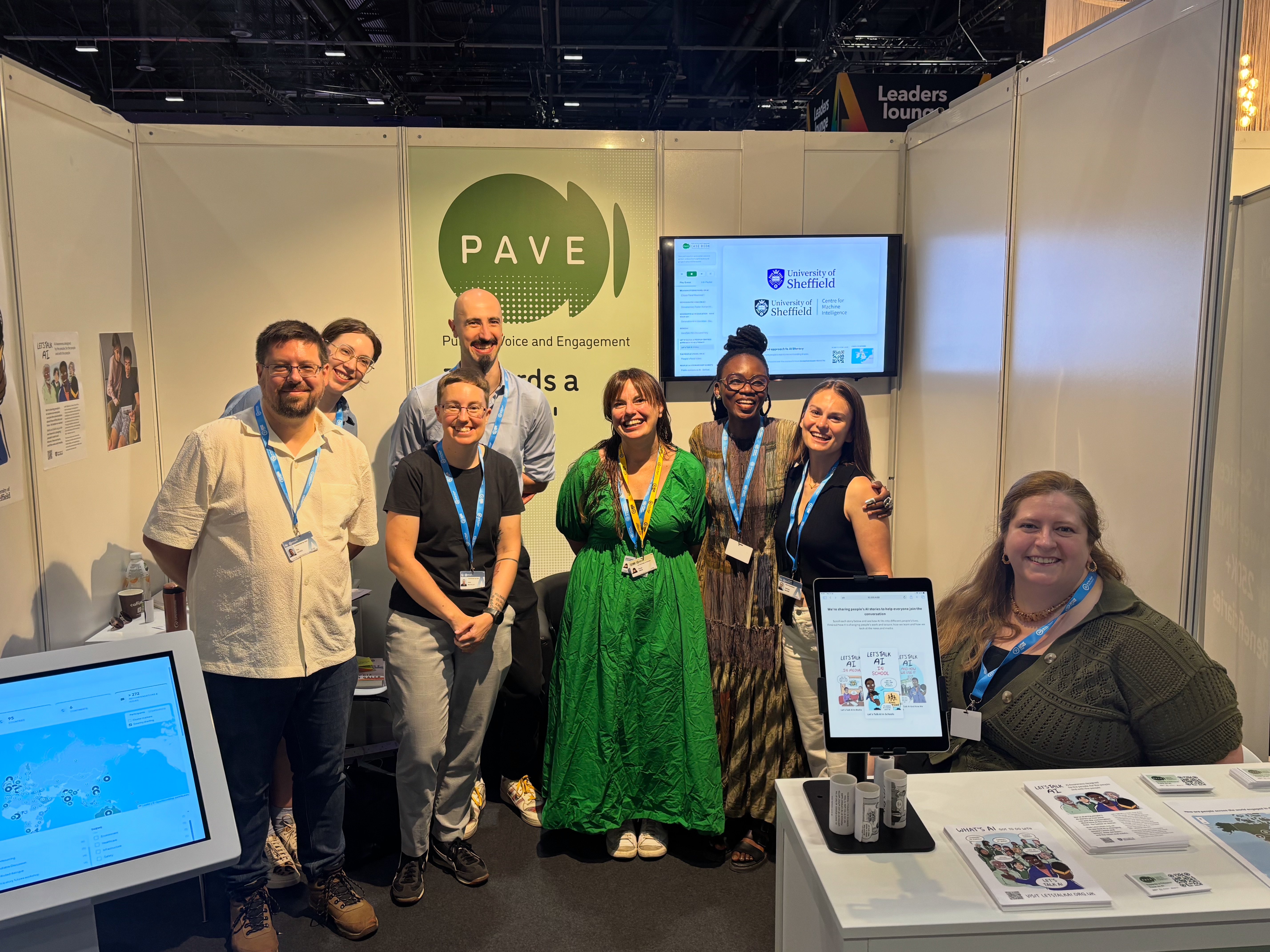 The PAVE Case Book team and PAIRS Stewards
The official figures say that over 12,000 people from 170 countries attended the Summit, and a good number of those will have wandered around the Expo.
This blog aims to capture what we learned about having a booth in this space – particularly to act as an aide memoire for us, and to inform similar initiatives we, or others, might plan, such as alongside the Global AI Summit (also in Geneva) in 2027.
We were promoting:
- Our desire to see (and therefore work towards) a Citizens’ Track on AI Governance
- The evidence for the above, through the Public AI Voices and Engagement (PAVE) Case Book
- An example of a case within the Case Book, Let’s Talk AI
- The value of research (which was a unique feature amongst the other booths) and current best practices in the field of participatory AI.
You can read a bit about how the idea of the booth came about here, and we’re immensely grateful to the University of Sheffield Centre for Machine Intelligence for the anchor support that made it possible.
Exploring the impact
We celebrate what we achieved within the short time frame (around 8 weeks from decision to delivery) and on limited resources: particularly compared to many of the industry-sponsored booths that surrounded us. It was a powerful demonstration of what partnership working - between a small team passionate about the message - can achieve. There were some things that we’d have liked to have done and weren’t able to (due to e.g. time, financial processes, international shipping rules, but the Booth was delivered with energy, enthusiasm and care.
We got sign ups to the mailing list, people said they’d submit a case in the PAVE Case Book and we had a handful of other discussions that felt like they may actually come to something that we’d be excited about.
The group discussions that were held in the Booth went really well. More of these or pop up sessions may have been good for people that are already engaged. We didn’t see evidence that people would stop for long to engage with a participatory exercise, though having an interactive element – particularly a quick one – is appealing (and was lacking on other booths).
We definitely spoke to a lot of people – and a diverse range of people – including people we hadn’t otherwise been in contact with. That feels, to us, like a real success: taking messages about public voice from side-events you would have to seek out, into mainstream spaces. Many more people have been prompted to think a little about including public voice in decisions about AI. And that can only be a good thing.
What we learnt: reaching the ‘audience’
In an Expo, the audience is “everyone”. Most people attending the Expo were promoting their AI products, looking for AI employment, or doing work with various communities on AI in NGOs. Most were not representatives of countries or those with power in the United Nations Global Dialogue on AI process (our primary target audience), though every so often one of these target stakeholders would come past. This means most people we spoke with did not know much about participatory work or public engagement.
When thinking about what to promote and the messaging, we found ‘Citizens’ Track’ was a term that generally only made immediate sense to people familiar with the UN process. It was not understood at first by most people that stopped by the booth. Our PAVE logo and branding (banner shown in image below) refers to “Public AI Voice and Engagement” with a tagline of “Towards a Citizens’ Track on AI”. Using two effectively interchangeable words (public and citizen) in close proximity caused some confusion as their meanings are understood differently by different people. A few memorable attendees thought we were promoting an AI tool that tracked the citizenship status of individuals and marketing it to countries who may be represented at the Expo. This last example is the most ironic as it is generally the opposite of the kinds of work we represented in the Case Book.
The Expo attendees were a global audience; English isn’t understood by all and is certainly not first language of many. We had (when the right staff were available) some conversations in French and had a handful of requests for information to be displayed in other languages. If we were doing this again then a mechanism for easy auto-translation on the devices would be ideal.
Related, in the future we need to think about how words translate into other languages and how the context can affect understanding of words. We experienced people stopping to talk to us that thought “voice” meant the technical production of sound and others that thought we were working on language-based LLM tools. We meant the “views” of the public – sometimes that took some explanation.
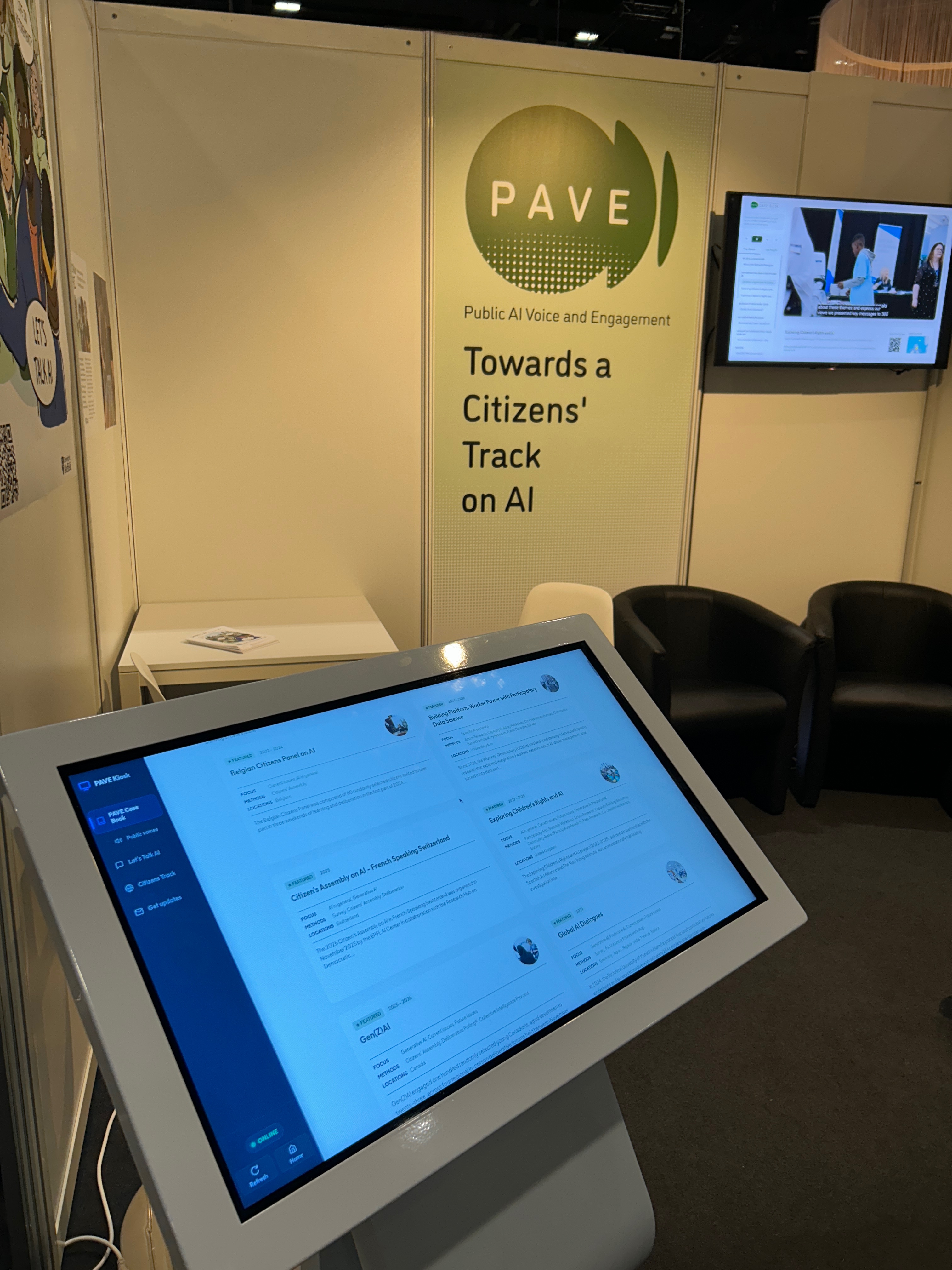 The PAVE Booth and Case Book touchscreen
We had an A0 poster of the Let’s Talk AI webtoon as well as leaflets and an iPad at the front of the Booth running the website. This was highly eye-catching and had the bonus of not needing English to be a first language. However we could have done more to explain how that linked with the Citizens’ Track on AI Governance and the PAVE Case Book. The webtoon led people into an AI literacy discussion which we couldn’t always link back into discussion of deliberative processes. This was part of the experimentation using a public engagement focussed booth to feature different projects, but in a future iteration we may want to choose either a single focus or (if the Case Book is the main thing being promoted) more (but not too many) examples of resources for public engagement drawn from the cases featured. We had discussed in early planning of the Booth an idea to have a small number of case studies printed out in a large flipbook. Lack of time and resources meant this wasn’t possible to deliver on this occasion.
Despite people therefore stopping by the booth with different ideas of what was on offer, after discussion and conversation with the team, people really seemed to like the “hope” we offered. Even if they weren’t involved or particularly interested in participatory practices, it’s hard to dislike the concept of people wanting agency.
It is worth noting however that we did experience a couple of strong push backs to our messaging and it’s worth having a plan / risk assessment in place for how to respond to that. Some attendees held strong opinions about the idea of public engagement - relating it to their own negative opinions of social media and election controversies. The goal wasn’t to win everyone over but to offer a different perspective. It was important to be clear in these kinds of strong or aggressive conversations the boundaries and limits of the project. For example, it is about lifting up marginalised voices. If people don’t like that - reiterating the purpose and agreeing to disagree are always fine strategies. Particularly for short, informal discussions, moving on quickly is always a useful step as well.
Related to this, when the capitalist sales pitch was strong across almost all other booths, starting our chat with words to the effect of “we’re not selling anything” / “we’re a not for profit coalition” engaged the right people’s attention. Amusingly it also massively confused people who simply couldn’t comprehend something not having a sales model. We had many people who repeated their question ‘but what is your business model?’ several times before they understood.
Having experts on the booth, even if not all the time, was essential. These were people who had facilitated the kinds of participatory processes for which we’re advocating; people who had read the cases we’ve mapped; and people who have been working in this area for a long time. It’s also ok to have people with quite superficial knowledge. Most people attended the booth for less than five minutes and had no knowledge themselves, so short key messages landed really well.
Your home for the week
We spent a lot of time on the booth during the week. It became our focal point for the duration and so its setup – for us and the attendees – was important.
On the booth we had:
- iPads (in heavy table top iPad stands) to make case studies (including the Let’s Talk AI webtoon) interactive
- A large wall mounted TV screen showing a loop of videos
- A 32” interactive screen on which we showed the PAVE Case Book; the map of cases in the Case Book; the Citizens’ Track on AI Governance website; the Let’s Talk on AI website; and a sign up email form
- Lots of A5 fliers promoting the Let’s Talk AI webtoon and campaign
- Business cards with a QR code on linking people to the PAVE website, and on the reverse side linking them to the Citizens’ Track on AI Governance website
- An experimental bluetooth printer that printed sections of the webtoons (we concluded that, whilst fun this was maybe not necessary / too much of a distraction. Plus the amount of bluetooth interference in the venue made it rather flaky!
- We had also hoped to have PAVE stickers but these did not arrive from the printers in time to be used
We learned:
- Less is more on a booth – and make it big. We’re not sure if anyone looked at / watched the TV screen on the back wall but they definitely saw the big PAVE banner in the centre of the back wall and the A0 comic style poster on the side wall.
- People really liked the large touchscreen although they generally didn’t play themselves but waited to be invited. We found having a map of cases from the Case Book onscreen was a great hook. Whatever their reason for being at the Expo, everyone likes to find their country (particularly when it’s a global audience).
- The touchscreen setup we had was amazing: it looked really professional and allowed us to easily switch between PAVE / Citizens’ Track and Let’s Talk AI. We also had a way of signing up to a mailing list through the touchscreen. However this was entirely down to a single member of the team, their coding knowledge setting up a Raspberry Pi.
- Chairs (more than stools) are great - there is a lot of standing around otherwise and that’s tiring. Two is essential, three is great.
- Take a range of cables and adaptors (unless you’re highly prepared and don’t want any flexibility). We changed our tech setup a couple of times and having that flexibility was really useful. This includes power adaptors (and specifically for Switzerland remember that this is different to the European socket). We plugged a UK extension lead into a single Swiss adaptor to make it easy for phone and laptop charging.
- We had a booth toolkit. We didn’t use it much but it’s one of those things that if you didn’t have it, you’d want it. Ours contained things like: cloths, wipes; first aid kit (including paracetamol and blister plasters); emergency sanitary towels provision; mini whiteboard and pens; pins and blu tack; double sided tape and heavy duty masking tape; bin liners and high vis jackets; pens and post its.
- It’s also worth having at least one person whose main (almost sole) focus is the booth. Knowing that they are there to anchor means other team members (the experts) can have the flexibility to do and be wherever they need.
It is worth us also noting that we were incredibly lucky with our booth location. We were at the top of the main stairs that everyone entered and left by, which meant we had a far higher footfall than might otherwise be the case. We had no choice in the specific location of the booth.
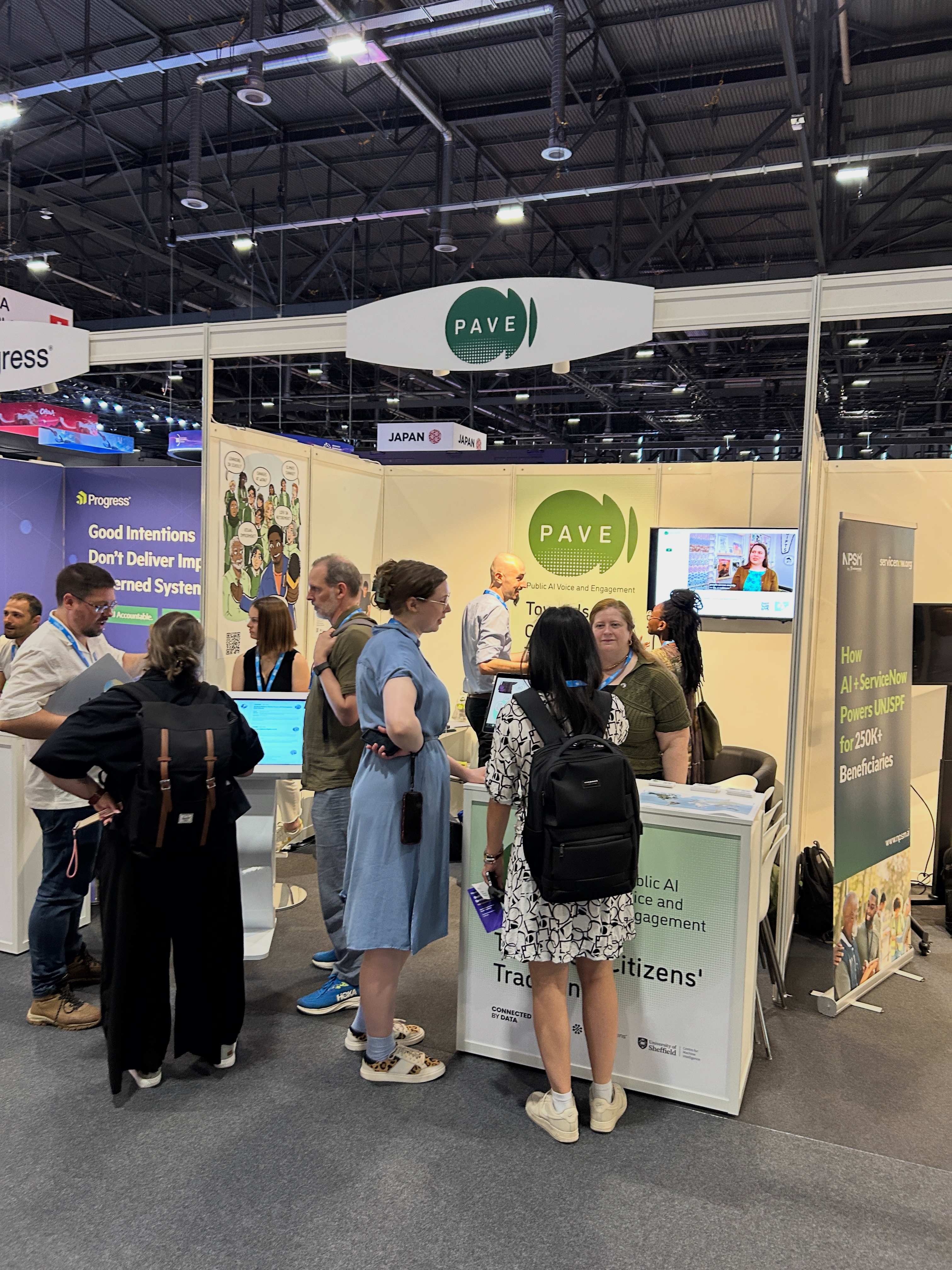 Interacting on the Booth
Practising what we preach
If you’re advocating for talking to the public, you’ve got to be able to talk to the public. Have a team on the stand that are willing to stand and talk to anyone about anything as they pass the Booth. Have enough people to be able to rotate, have breaks, and have quieter times. Ideally have people that enjoy chatting to each other too. In a perfect world, it also means having people that can speak different languages.
Through the Citizen’s Track on AI Governance mailing list we had asked for volunteers to support the booth. There’s a balance in this in that without all the prep and in-depth involvement it can be harder to ensure volunteers are delivering your messages. We tried to help with this by producing a single A4 sheet for key messages and sharing this in advance with a link to the Case Book for them to familiarise themselves with. The bonus of volunteers is that often they are highly passionate (as was the case for us on this occasion) and a number were practitioners too. This gives an added bonus to the booth whilst they’re there and often they bring languages other than English too. If they’re into social media and will shout out about having been on the booth, all the better. Our tip would be to make the effort to value this voluntary contribution. Welcome them, chat to them, show them around the Booth and give them a sense of how things have been going. If there’s a particular reason they’re involved and you can do something related as a “gift”, do it (e.g. someone had volunteered because of a piece of work a team member had done earlier in the year; we made sure they had a chance to sit down and have a 1:1 chat about that).
Why are you there?
Our Booth served three purposes through the week: promoting the four elements previously discussed; a meeting space for Citizens’ Track related group conversations; and a backdrop for social media and film footage to promote the three elements.
This all worked well and it was lovely to have the reasons for the whole team to come together at the booth. We had great engagement with Expo attendees; there were two group sessions with collaborators, with around six people chatting; and we got some great video footage.
But what didn’t work well was them happening at the same time.
A group of people sitting in a circle in a relatively small space looked like closed conversations and more Expo attendees tended to glance and walk by. The videoing needed a managed space and shots; posters and equipment were moved to be best placed for that, but then weren’t for engagement or group sessions. The exclusivity of each purpose wasn’t a problem in so far as the team seemed to accept that if one thing was happening the others wouldn’t be, but if doing this again it’d be worth considering what the priority activity was and if other activities could be more scheduled (and could be utilised as breaks / downtime for those focused on engagement). The other alternative would be to have a larger booth or a zone that allows for meeting space to be in one half and the engagement booth in another.
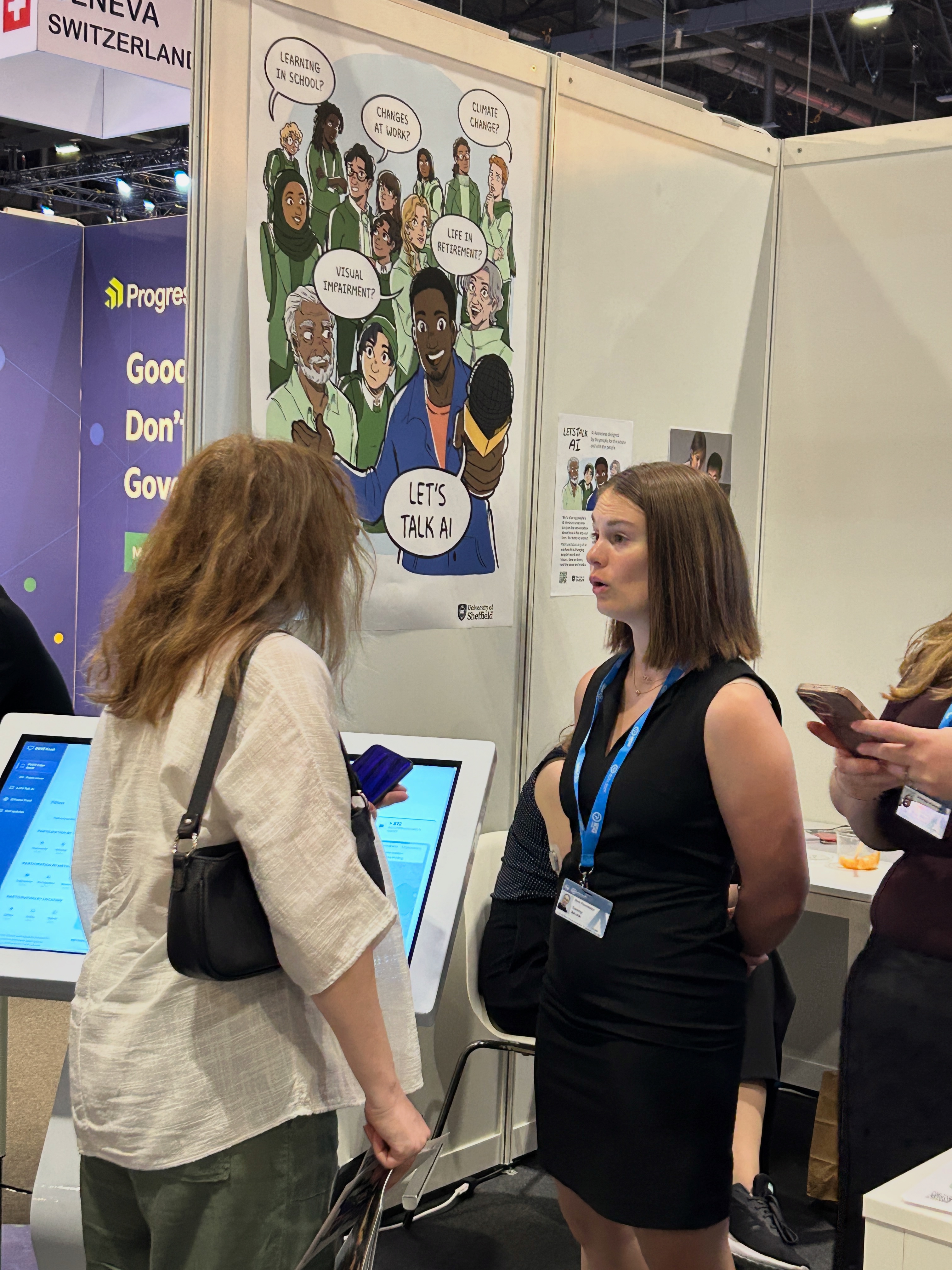 More interactions on the Booth
How will people continue to engage?
The QR code business cards seemed to go well and made sense to people (probably a handful of people commented on the environmental impact). We gave away around 300 across four days of booth and side events.
Neither PAVE nor the Citizens’ Track on AI Governance have their own social media presence so people couldn’t easily talk about us. There were a couple of posts turning the names into hashtags but we hadn’t promoted this anywhere. If posts were happening about us we won’t know (unless they tagged an individual team member too).
If people wanted to email us, the pairs@pairs.site email address was a little confusing for people - partly due to the proximity to ‘Paris’ but also as that wasn’t a word they’d heard or seen anywhere else and if it had to be explained it was another ‘thing’. (PAIRS is the “Participatory AI Research & Practice Symposium” which in part supported the creation of the PAVE Case Book). We often casually mentioned ‘yes this is an odd email address’ which helped people understand it was an unusual domain name. Next time a quick QR code on a large poster and an easier email interface may increase uptake of these onward communications.
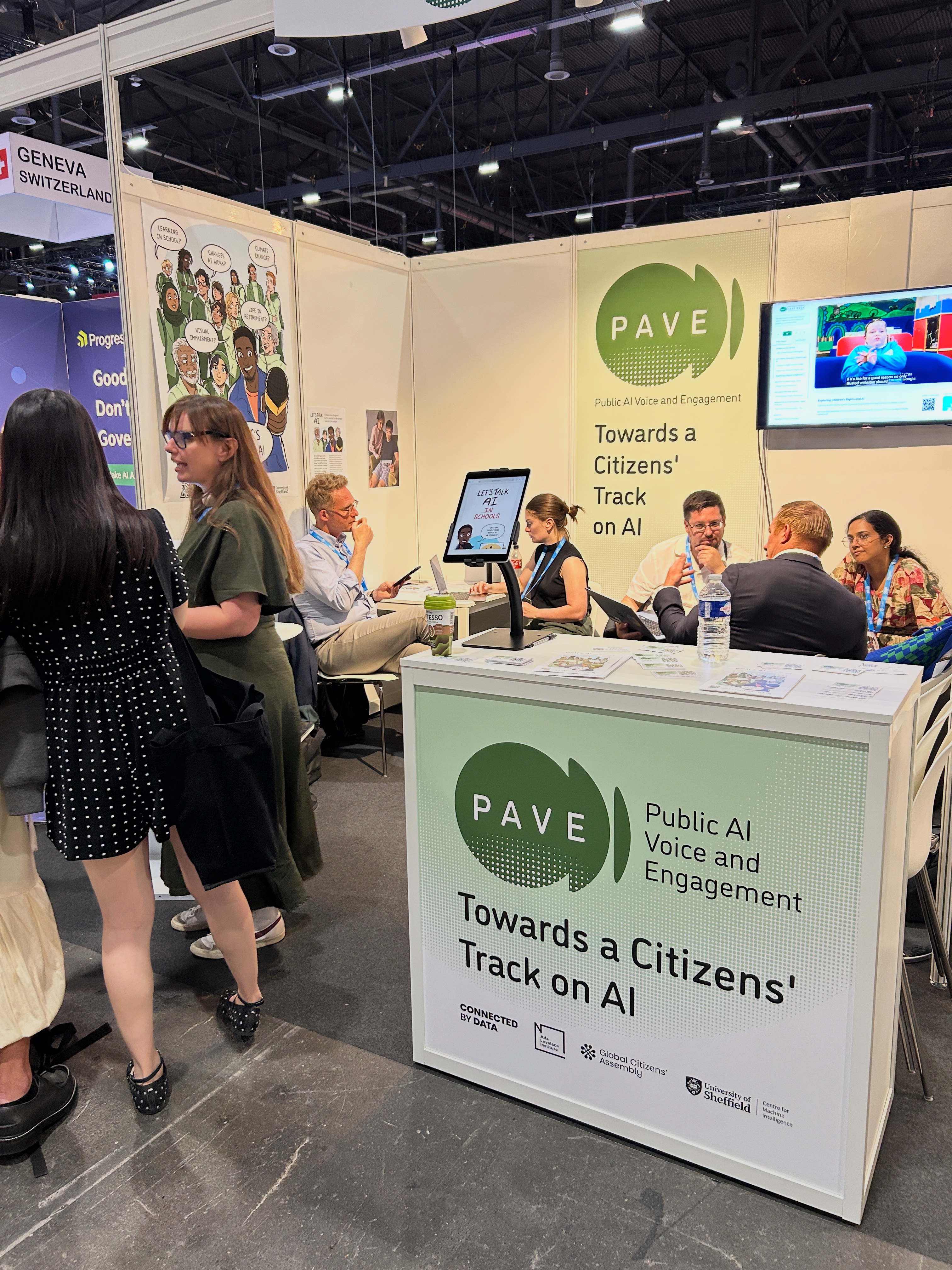 Multi-purpose Booth use
Next steps
Funding is actively being sought to continue - and increase - the work towards a Citizens’ Track on AI. The PAVE Case Book continues to exist and consideration is being given to how this is maintained and perhaps expanded in the future.
If you’d like to find out more about international participatory practice around AI visit https://pairs.site/
Authors: Emily Macaulay, Emily Rempel and Erin McCloskey